• Art
  • About
  • Museum Visits
  • Essays
  • Black and White
  • Music
  • Fringe Notes
  • Contact
  • Menu

Drew Burgess

  • Art
  • About
  • Museum Visits
  • Essays
  • Black and White
  • Music
  • Fringe Notes
  • Contact

Recreation by Jerome Thompson at the de Young

July 14, 2024

Recreation, Jerome Thompson, 1857, oil on canvas, 40 1/2”x 56”, M.H. de Young Memorial Museum

Ideas of the quality of the lives of people pervaded art of the 19th century. For example, the aesthetics of the Impressionists, centered in Paris of the 1870s, included roots in the movement of Realism, thus they explored everyday life, modernity, and the subject of leisure. Leisure is specific to Impressionist study. Consider Pierre-Auguste Renoir’s the Boating Party or Bal du moulin de la Galette—-each painting is a rooted example of the idea. Monet and colleagues were not directly political artists. There are no guns in Impressionist works. Degas’ dancers interestingly are at work, labor was strongly a subject in general during the investigations of the period, yet Degas’ dancers are within the notion of ‘art’ as an activity differentiated and included in the realm of leisure. Art, though a significant labor, refrains from announcing it. Instead, there is the ease of a dancer, the necessity of the art being the focus, not the exercise.

For some artists of the 19th century the rejection of politics as subject matter offered the effects of color and light as the sun filled expanse they needed to explore—they exemplified modernity as a landing party of the now.

So, the time frame of Jerome Thompson’s painting, Recreation, is rich with discussion of working life and time off. The painting offers marvelous artistry for our admiration and to some degree defines attitudes of nature, rest, and peaceful contemplation.

Who is Jerome Thompson? I am purposely stalling, to stay here, and experience this one painting. As an art educator how glorious it is to not know, to let a work unravel secrets.

My first observation is the figure reclining on the right, my eye settled there. We see the vision of the character gazing into the activity of the group but not the adjacent figure who is a mystery, with the backside to us, the character’s attention is solitary. One’s eye might follow hers to the figure below and then to the distant couple walking. Is there romance in her thoughts? In the long red dress, with figurative containment, the character is set apart from the activity of the group. I find some melancholy as there is a feeling of separation and longing. The reclining figure below looks elsewhere.

The central activity involves three people. The player of the flute with two distinct listeners. The admirers’ expressions are representations of personality. Are they sisters? The inner most of the two has a twist to her mouth while the other gazes with soft eyes.

The couple on the left counter the couple on the right. In this case the man looks lovingly upon the woman while she is somewhat aloof. Behind them the picnic fire smolders. The basket is nicely rendered. In the foreground a bottle is kept cold in a spring.

The expansive landscape, trees, foliage, and receding atmospheric light support the scene as a day of reflection in the comforts of nature. The player of music completes the scene as a harbinger of sweet romance and the divine possibility of the whole.

Following this visit my companion and I left the museum to stroll in Golden Gate Park. The meaning of the painting impressed me as I saw and felt the lovely environment.

By Drew Burgess

Drew Burgess is an art instructor at the College of Alameda of the Peralta Community College District of California.

Cite this page as: Drew Burgess, “Recreation by Jerome Thompson at the de Young” July 14, 2024, https://www.drewburgess.art/museum-visits/recreation-jerome -thompson/

Additional resources:
https://www.famsf.org/artworks/recreation

Joos van Cleve’s Lucretia at the Legion of Honor →

July 06, 2024

I am standing alone in the gallery. The Legion of Honor of San Francisco is free on Saturday. Arriving early, my path led to Lucretia by Joos van Cleve. On the freeway I wondered why, knowing I would see it first. My thesis is that we seek works that match the intricacies of emotion, the emotion we need to resolve.

Examining the surface, it is an oil painting on panel. The artist completed the work in 1525. The subject is the Roman story of Lucretia who chose suicide rather than the dishonor of rape. The surface has the quality of oil painting we might expect, the luster of the surface, fine detail, color, and design. The frame provides a strong harbor.

Like all paintings that captivate us, it is the way the artist conceives and executes the work—-the way it is done. The colors are special, the blue and pink tones. The blue is understated as a blue, rich in tone yet pale. The balance with the pinks of the garment and the pinks of the headwear create a delicate harmony. The colors are fresh. Lucretia’s fur wrap lends a different feeling, the sensation of brown tones, animal senses, and comfort. One can feel the tactile closeness of the fur in proximity with her pearly skin.

Lucretia’s agonizing gaze, specific and unique, is poignant. The expression carries  distraught emotion. Joos van Cleve created a tremendous interpretation of despairing realization—the character makes a choice within the narrow confines of her circumstances. The artist presents Lucretia as a person of anxious sensitivity, her eyes looking up to half closed lids. The eyes seem lost in a crazed moment of the action and exhilaration of holding her honor—the whole way. I see fear and courage in her face.

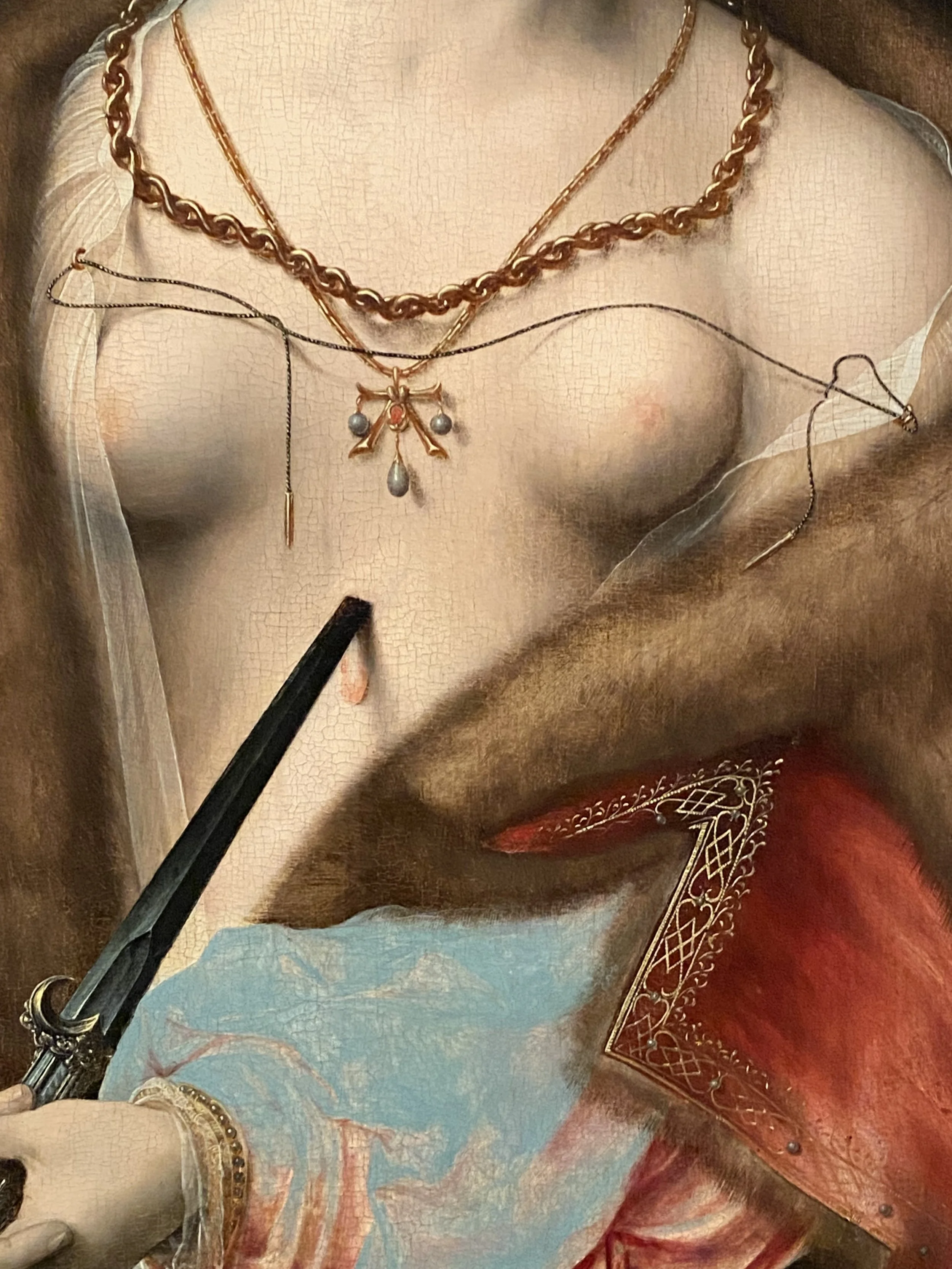
As for the dagger, the thrust is set to begin, the first drop of blood has started to flow. The hands hold the dagger as though an unfamiliar instrument, tentatively poised.

Jewelry pieces adorning her frame act in unison as a complicated network of angles, curves and crossings. The elements are both fragile and hard, the metal is a counterpoint to the so, so, soft skin and breasts. The sheer interior garment is spread open exposing her incredible vulnerability. The simple breasts represent complete exposure, her physicality and social stature.

The relationship of the hands, the dagger, and the two breasts has compositional power, the way the line of the units interact. As a viewer one senses the hardness of the steel dagger in contact with flesh and bone. One feels the abdomen and the sternum. The painting is charged with anticipation of the split seconds of activity.

Joos van Cleve painted Lucretia with her head tilted and her eyes countering the direction. The eyes and head turn from the action of the midsection as though the protagonist prepares to perform the excrutiating act.

The composition is achieved with a simple methodology—it is just Lucretia. The background is black without an expression of room space. For me the deep toned background counteracts the intense figure as a suggestion of the doomed space she must enter, her honor dictates her fate.

The translucent veil floating in the air suggests attendant angels. The veil on either side of the upper space suggests wings and perhaps transcendence to heaven—-she is a model of virtue. Her mortal courage in the face of barbarism will be met by an approving god.

One of the most sweetly portrayed articles of the painting is the looping string that has become undone from the metal loops of the inner garment. It is painted with extreme care. The gold ends, like so many details of the painting, speak on their own as singular elements, they rest with perfection on her skin and on the fur (appears to be mink).

The nipples of her breasts are tenderly colored a rosy hue. The way Master van Cleve felt the internal and external qualities of her softness is a marvel. Her eyebrows arch, a light brown color, they suggest a rising of the forehead, both in surprise and resignation. Her lips are parted as though drawing in breath to support her courage.

As a viewer I am struck with the dizzying quality of the event. Returning to my thesis, the mix of beautiful painting and a need for resolution fulfills something for me. Artists lead us to places we did not know we knew, and yet we do. We are confronted with brutality, tenderness, gentle sensibilities and human behavior. The elements of the painting lend a visual response of time that is quick, unforgiving, and determined. The physical space of the painting is charged with the action of Lucretia, a creature of purpose, unable to be anything but all that she is, an heroic woman honoring truth, her family, and her self.

By Drew Burgess

Drew Burgess is an art instructor at the College of Alameda of the Peralta Community College District of California.

Cite this page as: Drew Burgess, “Joos Van Cleve’s Lucretia at the Legion of Honor” July 6, 2024, https://www.drewburgess.art/museum-visits/joos-van-cleves-lucretia-at-the-legion-of-honor

Additional resources: https://www.famsf.org/artworks/lucretia

Joos van Cleve, Flemish, ca. 1485-1540, Lucretia, ca. 1525, Oil on Panel, Gift of the M.H. deYoung Endowment Fund to the M.H. de Young Memorial Museum, 54651

Joos van Cleve, Flemish, ca. 1485-1540, Lucretia, ca. 1525, Oil on Panel, Gift of the M.H. deYoung Endowment Fund to the M.H. de Young Memorial Museum, 54651 —-DETAIL

Joos van Cleve, Flemish, ca. 1485-1540, Lucretia, ca. 1525, Oil on Panel, Gift of the M.H. deYoung Endowment Fund to the M.H. de Young Memorial Museum, 54651 —-DETAIL

Prev / Next