George Caleb Bingham’s paintings portray a view of American opportunity and the complexities of self governance. This writing is based on a visit from the summer of 2024.
Two paintings at the M.H. de Young Memorial Museum, Boatmen on the Missouri, and The Country Politician, inspire reflection of the thoughts of Americans in the infancy of the country. The paintings compliment the Bingham painting at the Nelson Atkins Museum, Canvassing for a Vote. Each of the paintings are similar in size, compositional aesthetics, color, values, gradations, and space. They demonstrably convey the conversational qualities of George Caleb Bingham—the talkative aspects of his oeuvre. Each painting relies on three central charcters.
Boatman on the Missouri is a representation of slow moving river atmosphere. Working men are depicted on a woodhawk boat. The curation comments in the gallery state, “In the nineteenth century, major rivers served as interstate highways for steamboats carrying passengers and cargo. Missouri River steamboats were fueled by "“wood hawks,” men in small boats loaded with firewood.” The painting gives the washed-out haze of a sunlit day on the river and the suggestion of lapping of water.
The sense of day is achieved with gradated tones and a diffused horizon depicting a distant steamboat. Lavender color in the clouds blended with yellow touches, and the fading blue of afternoon, suggest the calm of the later part of a day. The line of tree’d hillsides is depicted as a wonderful series of modulated grays. The distant steamboat floats with a reflection and the smokestacks in an area of yellow-gray—-a beautiful painting in itself.
In the foreground, with deliberate provocation, are three characters. Two of the characters face the spectator. The third character bends over using a shovel. The man to the right is strongest with his arms folded, his height in the composition, and the the squareness of his position announcing his authority. Conversely the character to the left sits sideways and turns to his right to face the viewer. His arm supports his right leg, a leg with a bare foot. One might assume the others are barefoot as well, yet, his is the visible bare foot. His character may be interpreted in contrast to the character on the right, however subtle. My impression is influenced by his personal floppiness as his stovepipe hat is losing the stitched seam at the top and his pant leg is rolled up.
Each member of the boating crew wears a white shirt. The strong contrasts of color, the black stovepipe hat, and the black garment hanging off the corner of the boat, give anchorage for the softer cloth tonalities and the elements of texture such as the carefully cut wood pieces that are stacked and ordered. The stacked materials lend an idea of beauty of form as an outcome of labor. The character in the rear is at work, the two forward members are at rest.
Complimenting the pinkish-lavender-yellow of the sky is a soft and transitioning blue. Below and within the boat are blue tones, the man’s blue suspenders and a blue garment resting on the wood. Mr. Bingham utilized reds, whites, and blues.
Each man wears a hat with hair bursting from the sides. The baggy shirts, the body language and posturing offer a devil-may-care sense that one may interpret as American, a straightforwardness. Alex de Tocqueville noted in Democracy in America that Americans have an ease of sharing thoughts, “In America, where the privileges of birth never existed, and where riches confer no peculiar rights on their possessors, men unacquainted with each other are very ready to frequent the same places, and find neither peril nor advantage in the free interchange of their thoughts. If they meet by accident, they neither seek nor avoid intercourse; their manner is therefore natural, frank, and open: it is easy to see that they hardly expect or apprehend anything from each other, and that they do not care to display, any more than to conceal, their position in the world.”
The character to the right displays a no-nonsense frankness, he looks at you as though ready to square things up—man to man. I see no resentment, it is a marvelous face, strong, able, confrontational with bouyancy, humor, and grit. It is a face that speaks to American spirit and practicality.
The face of the man on the left is, oh, so different, slightly downcast by comparison. Are they brothers? Friends? The character on the left impresses me with casual rakishness, he is the moon to the other’s sun. The river is a home, these men are wed to the burgeoning aspects of a country in the process of becoming a place for individualized occupation. The painting resonates with yankee can-do spirit.
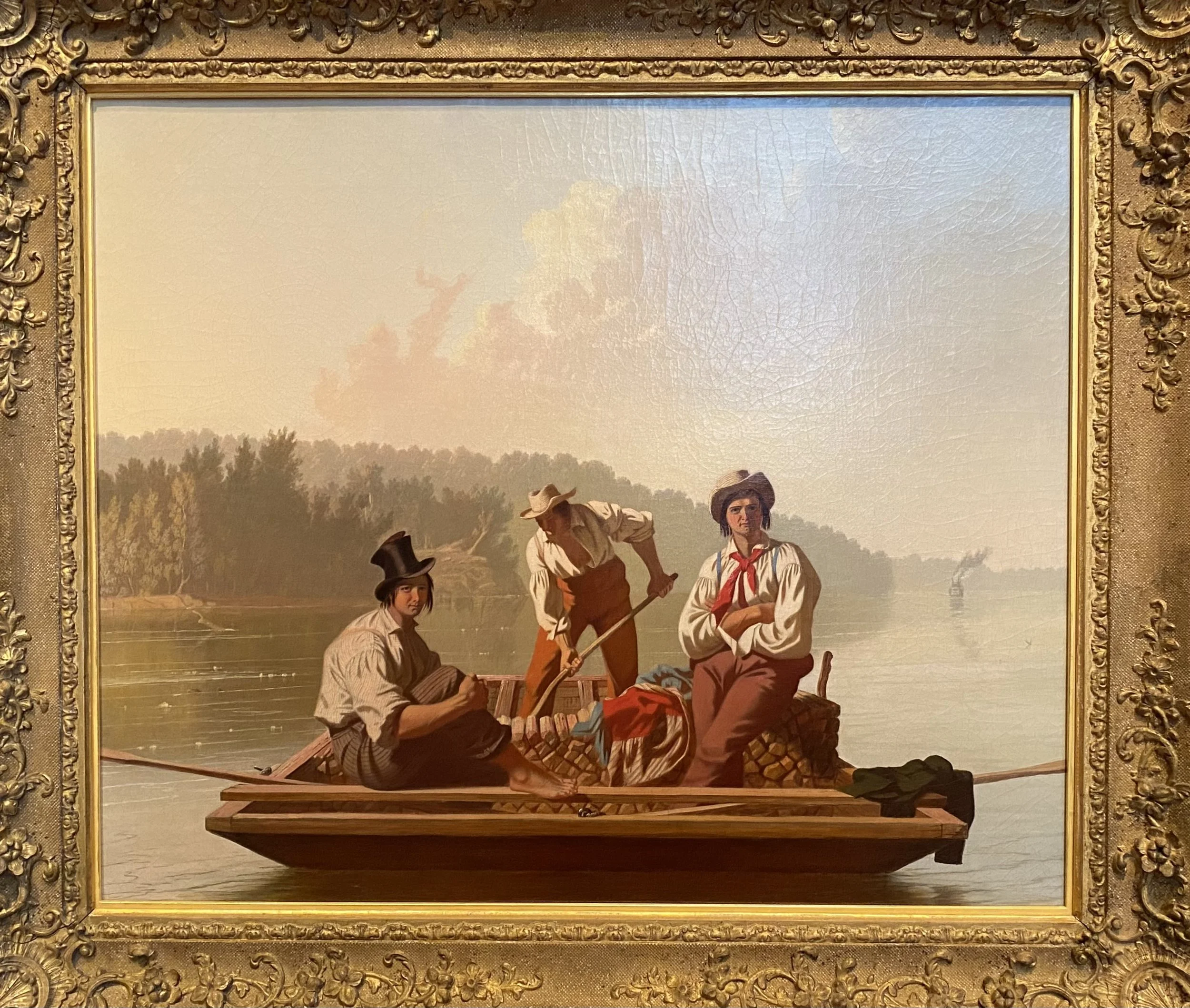
Boatman on the Missouri by George Caleb Bingham, M.H. de Young Museum, San Francisco
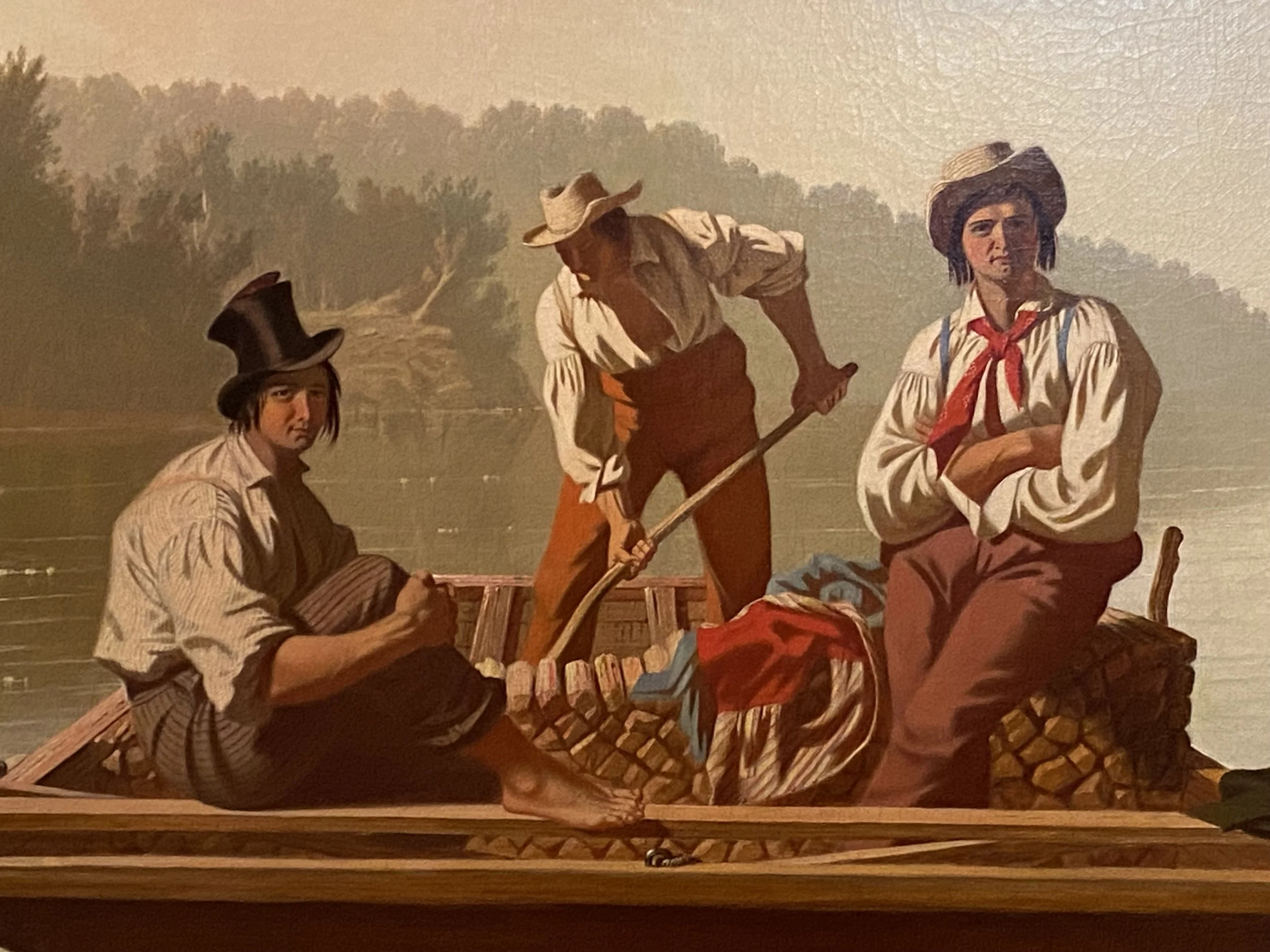
Boatman on the Missouri by George Caleb Bingham, M.H. de Young Museum, San Francisco

Boatman on the Missouri by George Caleb Bingham, M.H. de Young Museum, San Francisco
The Country Politicians, like its counterpart at the Nelson Atkins Museum in Kansas City, works with a triumvirate of physical engagement. The featured character on the right, gesticulates with active thought. One imagines vital political conversation, freedom of speech, and knowledge of such freedoms (however truncated in society). There is a rotund character acting as a balance to the dialogue, as the dialogue takes place. The background person gazes at a broadsheet. One has the sense that his attention is fixed allowing the conversation to be overheard by his activity, a reason to be there. The character gives me a feeling of one in the position of learning, of newspapers, and of the ‘goings-on’ of the world.
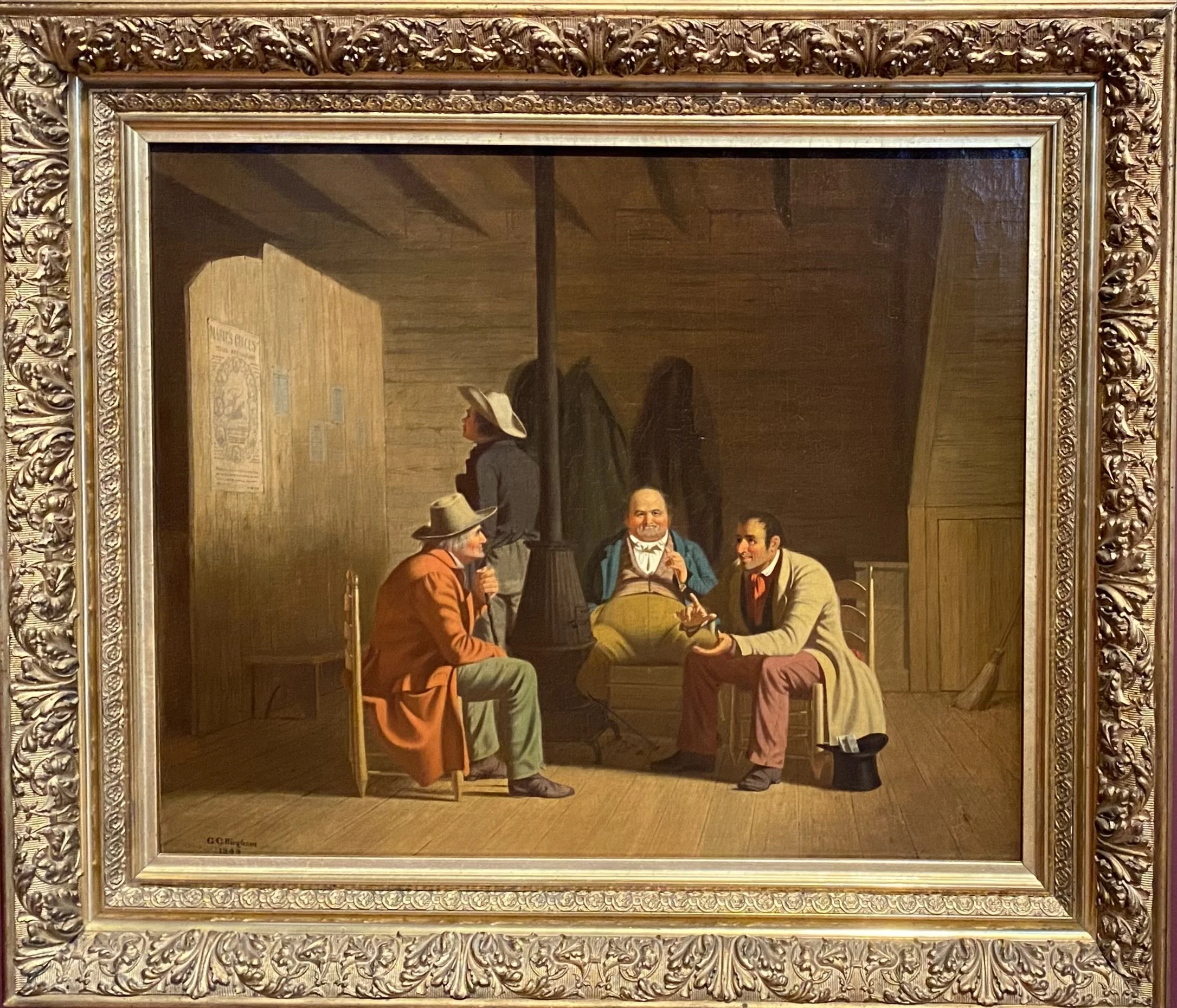
The Country Politician by George Caleb Bingham, M.H. de Young Museum, San Francisco
A foremost aspect of the painting is the way the men are seated and the importance of their footwear on the floor—the ground. The depiction of the ninety degree bent legs, at the knee, culminating with boots on the wooden floor is significant. The gestural qualities are completed as the figures rest their arms on legs, and lean-in to converse.
I respond to the way the characters are to each other and the room. The room reduces the amount of information to comprehend, like a stage set. The wood floor, the wood stove, act as elements of assurance, wood is primary to the survival and industry of the nation.

The Country Politician by George Caleb Bingham, M.H. de Young Museum, San Francisco

The Country Politician by George Caleb Bingham, M.H. de Young Museum, San Francisco
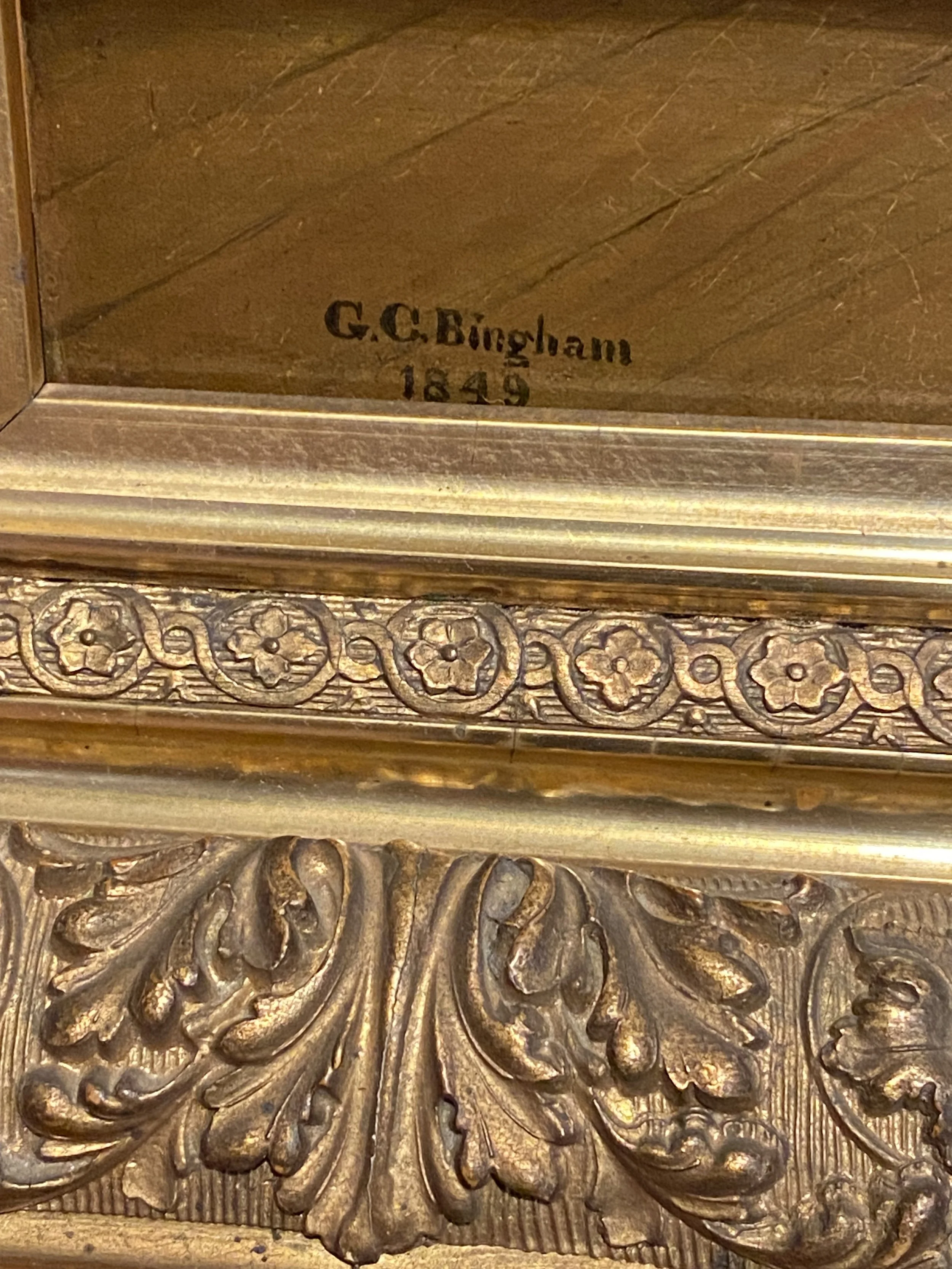
The Country Politician by George Caleb Bingham, M.H. de Young Museum, San Francisco
As I was writing about The Country Politician an elder woman was accompanied by a younger person. The elder woman, who seemed to want her viewpoint heard, said, “It is not great, but cute.” I thought that her comment completed the circle of American awareness and dialogue.
By Drew Burgess
Drew Burgess is an art instructor at the College of Alameda of the Peralta Community College District of California.
Works Cited:
Fine Arts Museums of San Francisco, "Boatmen on the Missouri," accessed July 19, 2026, https://www.famsf.org/artworks/boatmen-on-the-missouri
Fine Arts Museums of San Francisco, "The Country Politician," accessed July 19, 2026, https://www.famsf.org/artworks/country-politician
Nelson Atkins Museum of Art, "Canvassing for a Vote," accessed July 19, 2026, https://art.nelson-atkins.org/objects/2617/canvassing-for-a-vote
Alex de Tocqueville, “That Democracy Renders The Habitual Intercourse Of The Americans Simple And Easy” accessed July 19, 2026, Democracy in America, Book Three, Chapter Two, https://www.gutenberg.org/files/816/816-h/816-h.htm#link2HCH0043
Cite this Page: Drew Burgess, “Boatmen on the Missouri and The Country Politician by George Caleb Bingham”, July 19, 2026, https://www.drewburgess.art/museum-visits/2026/7/19/boatman-on-the-missouri-and-the-country-politician-by-george-caleb-bingham